
STAY SMART and UPDAted with the
Latest Tax Tips for Businesses & Individuals
How to Protect Your Company from 2026 CRA Audit Triggers
As we enter the final quarter of 2026, the Canada Revenue Agency (CRA) is stepping up its enforcement efforts. Firstly, thanks to expanded powers and advanced AI-driven pattern detection, the CRA’s ability to identify non-compliant taxpayers is more sophisticated than ever. Therefore, business owners can no longer rely on flying under the radar. Consequently, understanding what prompts an investigation is the best way to safeguard your hard-earned revenue. Meanwhile, taking proactive steps this fall ensures your books are pristine long before the new year arrives.
Why the CRA is Watching Closer in 2026
Audits are rarely random anymore. Instead, the CRA relies heavily on data matching, industry benchmarking, and cross-checking between various tax filings to identify targets. Moreover, when tax returns are processed, automated systems immediately flag mismatches before a human auditor even reviews the file. Consequently, even if you pay your taxes on time, simple administrative errors can invite immense scrutiny.
Top CRA Audit Triggers for Small Business
If you want to avoid an extensive and costly review of your financials, you must keep an eye on these specific red flags. Furthermore, minimizing these risks requires accurate documentation and strategic oversight.
1. Revenue Mismatches Across Filings
First and foremost, one of the easiest ways to trigger an audit is reporting conflicting information. For instance, if the revenue reported on your GST/HST returns does not match your T2 corporate tax return, the CRA’s automated systems will immediately flag the discrepancy. Additionally, missing T4A slips or reporting income that differs from the third-party slips the CRA already has on file is a guaranteed way to draw attention.
2. Expenses Growing Faster Than Revenue
Secondly, claiming deductions that are out of line with your industry average is a massive red flag. If your expenses are growing significantly faster than your revenue, or if they sit well above the benchmark for your sector, expect the CRA to request documentation. Specifically, auditors consistently target areas where personal and business uses blend, such as vehicle mileage, travel costs, and meals and entertainment. Therefore, you must maintain impeccable records, including detailed mileage logs and receipts, to prove the legitimacy of these claims.
3. Shareholder Loan Irregularities
Similarly, incorporated owner-managers face strict rules regarding how they move money out of their company. The CRA is heavily auditing shareholder loans in 2026. Specifically, they are looking for large debit balances owed by shareholders or loans outstanding beyond one year without a documented repayment plan. Ultimately, if these loans are not managed correctly, the CRA can reclassify them as personal income, resulting in severe tax consequences even if no cash permanently changed hands.
4. Unreported Digital and Gig Economy Income
Furthermore, the CRA has dramatically escalated its focus on digital assets and short-term rentals this year. Platforms like Airbnb and Uber are now required to report host and driver income directly to the CRA. In addition, if you are trading cryptocurrency, failing to report capital gains or missing foreign property reporting on T1135 forms (when holdings exceed $100,000) is a major audit trigger. Consequently, if money hits your bank account from any online platform, you must assume the CRA can see it.
Defend Your Business with Ricky Chawla CPA
Finally, you do not need to fear the CRA, but you do need to be prepared. If you receive an audit notice, ignoring it will only trigger automatic penalties. Instead, partnering with an experienced professional is the best way to resolve the issue favorably.
Backed by over 30 years of experience, Ricky Chawla CPA Professional Corporation provides robust audit defense, comprehensive bookkeeping, and strategic tax planning for businesses across Brampton and Mississauga. Thus, do not wait until you receive a letter from the CRA. Reach out to our team today to review your financials, strengthen your compliance, and ensure your business is fully protected as we head toward year-end.
This article is intended for general informational purposes only and does not constitute individualized tax, legal, or accounting advice. Eligibility for each program depends on the specific facts of your situation, including residency history, willfulness, and asset composition. If you believe you may have unreported foreign income or unfiled U.S. information returns, consult a CPA or tax attorney experienced in U.S./Canada cross border tax compliance before taking action.

Ricky Chawla
IRS Voluntary Disclosure for U.S. Citizens in Canada
If you are a U.S. citizen living in Canada, or a Canadian who became a U.S. tax resident through a green card, a work visa, or the Substantial Presence Test, there is a good chance nobody told you the United States expects an annual report of your worldwide income and your non-U.S. financial accounts.
This is one of the most common problems we see in cross-border practice. This guide explains why it happens, what it costs to ignore, and which IRS program is likely to fit your situation — including an important change the IRS made in July 2026 that removed one of the safest catch-up options.
This Guide Is For:
1. U.S. citizens living in Canada, including “accidental Americans” — people born in the U.S. who left as children, or who inherited citizenship from a parent. Many have filed Canadian returns faithfully for decades and assumed that was the end of it.
2. Canadians who became U.S. tax residents — through a green card, a TN, H-1B or L-1 visa, or simply by spending enough days in the U.S. to meet the Substantial Presence Test — who kept RRSPs, TFSAs, RESPs, Canadian mutual funds, rental property, or a corporation back home and never reported the income or the accounts.
If either describes you, and you have unreported foreign income or unfiled information returns (FBAR, Form 8938, Form 3520, Form 5471, Form 8621), the IRS has structured paths to get you compliant — often with reduced or eliminated penalties, provided your prior noncompliance was non-willful: a genuine mistake, not intentional evasion.
Note: this article does not cover the tax treatment of individuals who have already renounced or relinquished U.S. citizenship. That is a separate analysis with its own exit tax rules.
Why This Happens So Often
The United States is one of only a small number of countries that taxes based on citizenship, not just residency. A U.S. citizen owes U.S. tax on worldwide income no matter where they live. Green card holders and anyone meeting the Substantial Presence Test are taxed the same way for as long as that status continues.
Most people never hear this until something forces the issue. Common triggers:
• A Canadian bank asks for a U.S. tax ID under FATCA rules
• A green card or U.S. citizenship application requires proof of tax compliance
• An estate or inheritance matter requires disclosure of foreign accounts
• A cross-border move, retirement, or property sale prompts a first consultation
• An IRS notice arrives, already carrying penalties
By that point, several years — sometimes decades — of unfiled returns have piled up.
What’s at Stake If You Don’t Fix It
Ignoring the problem is the worst available option. Here is the exposure, using 2026 inflation-adjusted figures:
FBAR penalties (FinCEN Form 114)
Non-willful penalties reach $16,536 per report, per year. If the IRS deems the conduct willful, the penalty is the greater of $165,353 or 50% of the account balance, per violation, per year.
Willfulness is not limited to deliberate hiding. Courts routinely treat objective recklessness as willful — if a CPA, tax software, or an official notice flagged foreign account rules and the filer ignored it or failed to correct it within a reasonable time, that conduct often supports a finding of willfulness.
Form 8938 (FATCA) penalties
Up to $10,000 per form, plus an additional $10,000 for each 30-day period after IRS notice, capped at $50,000. A separate 40% accuracy penalty can apply to any underpayment tied to undisclosed foreign assets.
Form 3520 / 3520-A penalties
Applies to foreign trusts — and the IRS may treat a TFSA as one. Generally the greater of $10,000 or a percentage up to 35% of the value of the trust or transaction.
Form 5471 penalties (foreign corporations)
$10,000 per form, per year, plus $10,000 monthly continuation penalties capped at $50,000 — a maximum of $60,000 per form, per year. On top of the money, failure to file can trigger a 10% reduction in Foreign Tax Credits, with a further 5% reduction every 30 days after the 90-day notice period expires.
The statute of limitations never starts
Unfiled tax returns and unfiled international information returns keep the assessment clock from running. The IRS can look back indefinitely to assess tax, penalties and interest.
Passport and immigration consequences
Seriously delinquent tax debt can trigger passport restrictions, and unresolved noncompliance complicates immigration and citizenship applications. The good news: these disclosure programs exist precisely because the IRS recognizes
most of these people are not tax cheats. The penalty structures for non-willful taxpayers are designed to be proportionate, not punitive.
What Changed in 2026: The Delinquent FBAR Procedures Are Gone
On July 1, 2026, the IRS quietly removed the Delinquent FBAR Submission Procedures webpage with no announcement or explanation.
For over a decade, that program let a taxpayer who had reported all their foreign income and paid all their tax — but never filed the FBAR — file the late forms with a short explanation and receive an explicit no-penalty assurance. That assurance is now gone. The IRS guidance simply states that failing to file is a violation that may subject you to penalties, and directs taxpayers to file as soon as possible to keep penalties to a minimum.
What this does and does not mean:
• The underlying law has not changed, and penalties are not automatic.
• Internal Revenue Manual section 4.26.16.3.11 still contains delinquent FBAR filing
procedures, so the mechanism has not vanished from IRS internal guidance.
• What disappeared is the written guarantee. Relief is now discretionary and fact
dependent.
This follows a pattern. In 2020 the IRS removed the same kind of no-penalty assurance from the Delinquent International Information Return procedures. Three narrowings in eight years is a trend, not a coincidence — and it is the strongest argument for acting sooner rather than later.
The Main IRS Voluntary Disclosure Programs
There is no single “amnesty program.” The IRS offers several distinct paths. The right one depends on where you live, why you fell behind, and whether your conduct was willful.
1. Streamlined Foreign Offshore Procedures (SFOP)
Best fit: U.S. citizens living in Canada, or Canadians who became U.S. tax residents but now reside outside the U.S., who meet the non-residency test — generally, in at least one of the most recent three years they did not have a U.S. abode and were physically outside the U.S. for at least 330 full days.
What it requires:
• 3 years of delinquent or amended U.S. income tax returns, including all required international information returns (8938, 3520, 5471, 8621)
• 6 years of FBARs
• A signed non-willfulness certification, Form 14653
The benefit: No FBAR penalty and no offshore penalty whatsoever. This is the most favorable program available, and it is the one most U.S. citizens permanently residing in Canada will qualify for. SFOP also allows original returns to be filed, not just amendments — which matters if you have never filed at all.
2. Streamlined Domestic Offshore Procedures (SDOP)
Best fit: Canadians who became U.S. tax residents and now live inside the United States, so they fail the non-residency test above, and whose prior non-reporting was non-willful.
What it requires:
• 3 years of amended U.S. income tax returns, including information returns
• 6 years of FBARs
• A signed non-willfulness certification, Form 14654
• A 5% miscellaneous offshore penalty
How the 5% is calculated: you take the total combined year-end value of all covered assets for each of the six years, identify the single highest year, and apply 5% to that figure once — not 5% per year.
The benefit: a penalty applies, but it is dramatically lower than the exposure outside these
programs, and it resolves multiple years in one filing.
3. Delinquent International Information Return Submission Procedures (DIIRSP)
Best fit: Someone who reported and paid tax on all income correctly but missed a specific information return — a Form 3520, or a Form 5471 for a Canadian corporation — where no tax is owed.
What it requires: File the delinquent returns with a reasonable cause statement. Depending on which form was missed, amending the related income tax return may also be required.
The benefit: If reasonable cause is accepted, severe penalties are typically abated. Be aware that since 2020 the IRS no longer guarantees abatement here — each submission is reviewed on its own facts. This route carries more uncertainty than Streamlined, but it is appropriate when income tax itself was never at issue.
4. Late FBAR Filing (Post-July 2026)
Best fit: Someone who reported all foreign income correctly but never filed the FBAR — the taxpayer the old Delinquent FBAR Submission Procedures were designed for.
What it requires: File the late FBARs electronically through FinCEN’s BSA E-Filing System, selecting a reason for late filing on the cover page.
The benefit: Penalty relief is still realistically achievable on reasonable cause grounds, but it is now discretionary rather than assured. Filing before the IRS contacts you remains the single most important factor.
5. IRS Voluntary Disclosure Practice (VDP)
Best fit: Taxpayers whose past noncompliance may be willful, or who have exposure that could be viewed as criminal — knowingly hiding income or foreign assets. This is not the typical situation for someone who simply didn’t know the rules, but it is the right program when willfulness cannot be ruled out.
One critical warning: written and verbal communications with a CPA or tax preparer can be summoned by the IRS and used as primary evidence of willfulness. If willfulness is a live question, the first call should be to a tax attorney, who can extend privilege — including over the accountant’s work, through a Kovel arrangement.
What it requires: A multi-step process beginning with a pre-clearance request to IRS Criminal Investigation, followed by full disclosure and up to 6 years of returns. The benefit: Protection from criminal prosecution, with civil penalties negotiated — generally higher than the 5% streamlined penalty, often calculated on the highest account balance across the disclosure period.
Comparing the Programs at a Glance
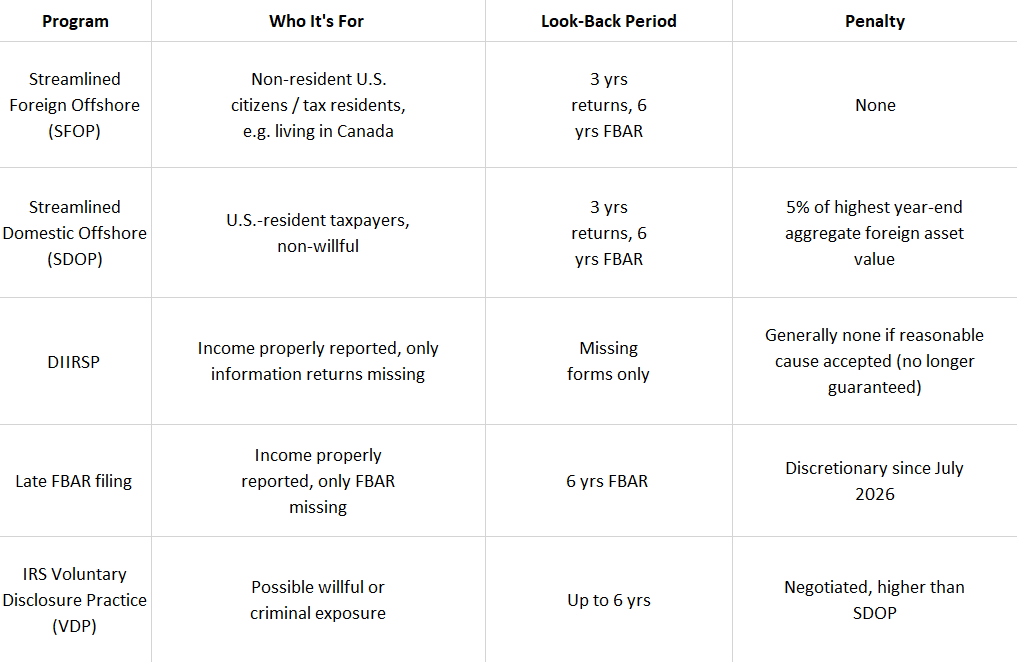
Canadian-Specific Traps to Know About
Ordinary Canadian savings and investment vehicles carry unexpected U.S. reporting consequences:
RRSPs and RRIFs
Since 2014 these generally no longer require a separate election or the old Form 8891, and
they receive favourable treatment under the Canada-U.S. tax treaty. But historical years
may still need review, and they remain reportable on the FBAR and Form 8938.
TFSAs
The IRS does not recognize the tax-free character of a TFSA. It is often treated as a foreign grantor trust, potentially triggering Forms 3520 and 3520-A, and all income inside it is taxable on the U.S. return. The single most expensive account in a typical Canadian portfolio, from a U.S. perspective.
Canadian mutual funds and ETFs
Frequently classified as Passive Foreign Investment Companies (PFICs), triggering onerous Form 8621 reporting and, without a proper election, punitive default tax treatment that can approach confiscatory rates on long-held positions.
Principal residence
Canada’s principal residence exemption has no exact U.S. equivalent. The U.S. capital gain
exclusion on a home sale has different dollar limits and eligibility rules, so a Canadian
home sale can create real, unexpected U.S. tax.
Canadian corporations
Owning a Canadian-controlled private corporation can trigger Form 5471 and, depending on structure, exposure to GILTI rules. Form 5471 is among the most demanding IRS forms — most of the work is building foundational workpapers before form preparation even begins.
Compliance costs for a simpler Form 5471 typically range from $1,000 to $2,000+ perform, depending on the state of the foreign financial statements, GILTI calculations, available international elections, and structural complexity. A dormant entity with no activity can be filed for a baseline fee of $500.
Two Illustrative Scenarios
Scenario A — The accidental American in Toronto. A U.S.-born citizen has lived in Toronto her entire adult life, filing Canadian returns and paying Canadian tax, but never filed a U.S. return because she didn’t know she had to. She holds an RRSP, a TFSA, and a Canadian brokerage account. Because she lives outside the U.S. and meets the physical
presence requirement, she is a strong candidate for SFOP — 3 years of returns, 6 years of FBARs, and no penalty. Her TFSA and any mutual funds will drive most of the preparation work.
Scenario B — The Canadian who moved south. A Canadian citizen moved to the U.S., became a U.S. tax resident, and kept a Canadian bank account and a mutual fund account, neither ever reported. Because he now lives in the U.S., he fails the non-residency test, so SDOP applies — the same 3-year and 6-year filing requirement, but with a 5% penalty on
the highest combined balance of the unreported foreign assets.
Steps to Take
1. Get a complete picture first. Before filing anything, gather account statements, RRSP/TFSA/RESP records, and prior Canadian and U.S. filings for the full look-back period.
2. Assess willfulness honestly. This determination drives which program applies. It should be made with a qualified cross-border professional, not assumed — and if the answer is unclear, involve a tax attorney before creating a paper trail.
3. Determine your U.S. residency status. Whether you meet the non-residency test for SFOP versus SDOP turns on facts and circumstances, not on which passport you hold.
4. Prepare returns and information forms together. These programs require multiple years filed simultaneously, as one coordinated package — not one year at a time.
5. File once, correctly. Streamlined submissions generally cannot be undone or resubmitted. Accuracy on the first attempt matters more here than on almost any other filing.
6. Consider state tax exposure. If you have ties to a U.S. state, its voluntary disclosure program is separate from the federal ones described here.
7. Move before the IRS moves. Every program above becomes unavailable once you are under civil examination or criminal investigation, or once the IRS contacts you about the missing filings.
Talk to a Cross-Border CPA Before You File
Coming forward proactively — before the IRS identifies you through FATCA data matching — almost always produces the better outcome: lower penalties, a defined scope, and a clean slate going forward. Waiting produces the opposite, and the 2026 changes show the safe harbors are narrowing, not widening.
Ricky Chawla CPA Professional Corporation works with U.S. citizens in Canada and Canadians who have become U.S. tax residents on exactly these filings — determining program eligibility, preparing the coordinated multi-year package, and handling the Canadian side of the return at the same time.
This article is intended for general informational purposes only and does not constitute individualized tax, legal, or accounting advice. Eligibility for each program depends on the specific facts of your situation, including residency history, willfulness, and asset composition. If you believe you may have unreported foreign income or unfiled U.S. information returns, consult a CPA or tax attorney experienced in U.S./Canada cross border tax compliance before taking action.
Ricky Chawla
Navigating the Final Quarter: Why Fall is the Perfect Time for Year-End Tax Planning
As the crisp autumn air settles in and we head into September, most business owners are naturally focused on closing out the final quarter of the year strong. However, while you are busy managing day-to-day operations, it is crucial not to overlook your financial health. At Ricky Chawla CPA Professional Corporation, we know that waiting until spring to think about your taxes is a missed opportunity. Consequently, early fall is the ideal time to review your financial records and implement proactive tax measures before the December 31st deadline.
Why You Need a Proactive CPA in Mississauga for Q4
When it comes to optimizing your finances, partnering with a knowledgeable CPA in Mississauga can make a world of difference. Furthermore, Ricky Chawla, CPA, CA, brings over 30 years of extensive experience—including senior roles at Deloitte Canada and Great-West Lifeco—to help you minimize liabilities and maximize your returns. Therefore, engaging an expert now allows you to strategize effectively rather than scrambling during tax season.
Here are a few key strategies you should be considering this time of year:
1. Optimize Your Corporate Tax Position
First and foremost, reviewing your year-to-date profit and loss statements in early September gives you a clear picture of your anticipated year-end tax burden. In addition, an experienced accounting firm can help you identify opportunities for capital cost allowance (CCA) planning. For instance, if you plan to purchase new equipment, doing so before the end of your fiscal year can provide immediate tax deductions.
2. Implement Income Splitting and Compensation Strategies
Moreover, fall is the perfect time to evaluate how you pay yourself and your family members. Whether through dividends or a salary, structuring your remuneration efficiently can significantly reduce your overall household tax burden. Specifically, we can help you navigate the complex CRA rules around income splitting to ensure you remain fully compliant while taking advantage of available tax credits.
3. Claiming Tax Losses and Deductions
Another vital strategy involves reviewing your investment portfolio and business assets. If you have realized capital gains earlier in the year, you might consider selling underperforming assets to trigger capital losses. Consequently, this strategy—commonly known as tax-loss harvesting—can offset your gains and lower your tax bill, a tactic our firm frequently leverages for clients with diverse portfolios.
Staying Ahead of CRA Reviews and Audits
On the other hand, aggressive tax planning can sometimes trigger scrutiny from the Canada Revenue Agency (CRA). As a result, maintaining immaculate records is essential. Whether you run a personal services business (PSB) in trucking, IT consulting, or construction, the CRA is increasingly scrutinizing these sectors. Thus, having a dedicated accounting partner ensures your bookkeeping is spotless and audit-ready. In fact, our firm provides full CRA audit representation, giving you total peace of mind.
In conclusion, the decisions you make this autumn will directly impact your tax return next spring. Therefore, don’t wait until the last minute. Whether you need assistance with corporate tax filings, U.S. tax compliance, or simply reliable bookkeeping, our team is here to guide you. We proudly serve clients across Mississauga, Brampton, Oakville, and the broader GTA. Take control of your financial future today and position your business for success as we close out the year.
This article is intended for general informational purposes only and does not constitute individualized tax, legal, or accounting advice. Eligibility for each program depends on the specific facts of your situation, including residency history, willfulness, and asset composition. If you believe you may have unreported foreign income or unfiled U.S. information returns, consult a CPA or tax attorney experienced in U.S./Canada cross border tax compliance before taking action.
Ricky Chawla
Fall 2026 Corporate Tax Strategies: Navigating Ontario's Mid-Year Rate Cuts
Many business owners scramble in the spring to minimize their tax liabilities, but the real savings are locked in during the fall. Firstly, waiting until after your fiscal year-end limits your options to retroactive adjustments rather than proactive structuring. Therefore, assessing your corporate financials now gives you the runway to implement effective capital investments, optimize owner compensation, and adapt to the mid-year 2026 provincial tax rate changes.
Why Fall is the Critical Window for Strategy
Managing a Canadian-controlled private corporation (CCPC) requires constant adjustment to legislative shifts. Moreover, when tax policy changes in the middle of a calendar year, as it did this past July, estimating your final tax bill becomes significantly more complex. Consequently, executing a mid-year review prevents cash flow surprises and allows you to reinvest surplus capital before December 31st. Meanwhile, gathering your documentation early ensures you are insulated against increasingly aggressive Canada Revenue Agency (CRA) audits.
Essential Corporate Tax Planning in Brampton
For businesses operating in the Greater Toronto Area, minimizing your combined federal and provincial tax burden is crucial for growth. Furthermore, applying these specific strategies before year-end can dramatically improve your corporate bottom line.
Leverage the 2026 Ontario Small Business Tax Cut
Effective July 1, 2026, the Ontario small business corporate income tax rate decreased from 3.2% to 2.2% on the first $500,000 of active business income. In addition, because this cut landed mid-year, most CCPCs with a calendar fiscal year will pay a prorated, blended provincial rate of approximately 2.7% for the 2026 tax year.
- Income Deferral: If your cash flow allows, deferring invoicing or accelerating expenses into the current year while pushing revenue into 2027 lets you take full advantage of the lowered 2.2% rate for the next full fiscal period.
- Blended Rate Calculation: Work with your accountant to calculate your exact transitional rate based on your specific fiscal year-end dates to avoid underpaying or overpaying installments.
Optimize Your Salary vs. Dividend Mix
Secondly, owner-manager compensation requires a delicate balance between generating personal RRSP room and minimizing corporate outflows. However, the 2026 provincial corporate rate cut also impacts the dividend tax credit mechanics.
Compensation Type | Corporate Impact | Personal Tax Impact |
Salaries/Bonuses | Deductible expense for the corporation; reduces taxable income. | Generates RRSP room; requires CPP contributions. |
Dividends | Paid from after-tax retained earnings; no corporate deduction. | Taxed at a preferential rate via the dividend tax credit; does not generate RRSP room. |
Ultimately, forecasting your personal cash requirements now allows you to declare the most tax-efficient mix of T4 and T5 income before the calendar year closes.
Prepare for CRA Scrutiny on Personal Services Businesses
The CRA is heavily scrutinizing incorporated independent contractors—particularly in trucking, IT consulting, accounting, and construction. Consequently, if you operate as a CCPC but function effectively as an employee to a single client, you are at risk of being reclassified as a Personal Services Business (PSB).
- The Risk: PSBs are denied the small business deduction and face a punitive combined tax rate well over 40%.
- The Solution: Review your independent contractor agreements, ensure you use your own tools, take on financial risk, and maintain multiple clients to strengthen your independent corporate status.
Accelerate Capital Cost Allowance (CCA)
If you plan to upgrade your fleet, purchase manufacturing equipment, or invest in new IT infrastructure, finalizing those transactions before your fiscal year-end is vital. Accordingly, acquiring and putting assets into use before the deadline allows you to claim the CCA deduction in the current tax year, instantly reducing your taxable corporate income.
Secure Your Corporate Wealth with RCTAX
Finally, navigating shifting tax brackets, complex CRA compliance, and advanced remuneration strategies should not be done alone. Led by Ricky Chawla, a CPA with over 30 years of extensive financial advisory and audit experience, RC CPA Professional Corporation provides the deep expertise required to optimize your corporate structure.
Thus, whether you need comprehensive bookkeeping, holding company restructuring, or robust audit defense, our Brampton and Mississauga teams are ready to assist. Do not wait until tax season to discover what you owe. Contact RC CPA today to solidify your corporate tax strategy and ensure your business retains the wealth it has built.
This article is intended for general informational purposes only and does not constitute individualized tax, legal, or accounting advice. Eligibility for each program depends on the specific facts of your situation, including residency history, willfulness, and asset composition. If you believe you may have unreported foreign income or unfiled U.S. information returns, consult a CPA or tax attorney experienced in U.S./Canada cross border tax compliance before taking action.
Ricky Chawla
Facing a CRA Review Letter? How to Protect Your Deductions
Understanding the Post-Assessment Audit Wave
Why You Received a Letter After Filing
First, many taxpayers believe that receiving a Notice of Assessment means their tax return is permanently finalized. However, the Canada Revenue Agency routinely conducts massive post-assessment screening campaigns throughout the summer months. During this phase, compliance officers select processed returns to verify specific claims such as childcare costs, moving expenses, or medical deductions. Therefore, getting a verification notice does not mean you did anything wrong, but it does mean you must now provide clear documentation to back up your figures.
The Reality of the Strict 30-Day Response Window
Second, when the CRA issues a processing review letter, they enforce a non-negotiable 30-day timeline for your reply. If you ignore this notice or ask for extensions without a valid reason, the agency will automatically disallow your deductions. Consequently, they will issue a new Notice of Reassessment that leaves you with a substantial balance due. Because the agency moves quickly on automated adjustments, treating this letter with immediate urgency is the only way to safeguard your hard-earned refund.
The True Cost of Non-Compliance
Facing High Compound Interest Rates
Third, failing to satisfy a review agent leads to immediate financial consequences. Currently, the CRA interest rate for overdue personal taxes stands at a high 7%. Because this interest compounds daily from the original April filing deadline, a small adjustment can quickly snowball into a massive liability. Thus, attempting to delay your response or submitting incomplete receipts will directly cost you extra money in penalties and growing interest charges.
Why Proper Receipt Organization Saves Your File
Fourth, submitting a messy or unorganized stack of documents often triggers a deeper, full-scale tax audit. When a review officer receives unclear or mismatched invoices, they are highly likely to expand their investigation into your previous tax years. On the other hand, organizing your receipts cleanly beside a professional summary sheet shows compliance and accuracy. As a result, presenting your evidence in a structured format allows the reviewer to approve your files quickly and close the review without further complications.
Taking Action with Professional Support
Why Professional CPA Representation Matters
Ultimately, handling official tax disputes on your own can be an incredibly stressful experience. While basic digital tools can help you track standard numbers, they cannot speak to a live auditor or defend a complex deduction. By partnering with an expert CPA firm, you ensure that your response letters are written with precision and loaded with acceptable tax proof. Working with a dedicated professional gives you total peace of mind while protecting your financial interests before the CRA deadline expires.
Ricky Chawla
Maximizing Year-Round Business Tax Deductions
3 Reasons to Check Your Corporate Tax Setup Today
1. Realignment of Salary vs. Dividends Split
First, as an incorporated business owner, you likely split your personal income between a regular salary and corporate dividends. However, your personal cash needs and business revenue may have changed significantly over the last six months. Therefore, reviewing this split right now allows you to avoid landing in a higher individual tax bracket by December. If you wait until the winter to balance these books, you miss out on proactive strategy.
2. Strategic Corporate Tax Installments Optimization
Second, many small businesses pay their corporate tax installments based on what they earned last year. Meanwhile, if your business revenues have fluctuated recently, your mandatory payment amounts might be completely inaccurate. If you are overpaying, you are giving the government an interest-free loan and hurting your cash flow. Conversely, if you are underpaying, the CRA will apply severe interest penalties. Consequently, adjusting these installments at mid-year keeps your cash right where it belongs.
3. Moving Away from the December Panic
Third, most business owners dread the year-end crunch because they have to dig through months of old receipts and invoices. But, if you implement clean digital tracking today, you can eliminate that stress entirely. This simple mid-year cleanup ensures that your bookkeeping remains accurate and flawless. As a result, you will protect your business deductions well before the tax deadlines arrive.
Clear Tracking of Mixed Business and Personal Expenses
Furthermore, regular tracking protects you if you face a sudden CRA review or verification check later in the year. Business owners frequently overlook the fact that the CRA conducts compliance reviews long after the spring filing rush is over. For example, if you claim vehicle expenses, home office space, or travel costs, you must back those claims with clean mileage logs and matching invoices. Therefore, updating your financial records monthly ensures that you always have the necessary proof ready to go, effectively neutralizing any unexpected tax disputes.
Capitalizing on Smart Investment Strategies
Additionally, looking at your financial setup early gives your corporation the room to utilize advanced planning tools. Because the CRA prescribed interest rate is locked at 3% for the third quarter of 2026, corporate shareholders have unique, time-sensitive options for restructuring employee or shareholder loans. When you address these specialized wealth structures during the summer, you give your team the time required to set up legal documentation correctly. Consequently, you save money on taxes without triggering aggressive audits down the road.
Evaluate and Update Your Growth Plan
Ultimately, tax planning is not a one-time event that ends in the spring. Instead, a successful corporate tax strategy requires a proactive approach throughout the calendar year. By sitting down with an expert now, you can keep your corporation fully optimized, steady, and audit-ready.
The Value of Proactive Tax Advisory Services
Ultimately, true corporate tax strategy is about looking out the front windshield rather than staring at the rearview mirror. While basic accounting software simply records your historical data, a dedicated CPA helps you map out your future corporate moves. Working with a professional through the middle of the calendar year ensures that you can bounce ideas off an expert before you make big financial purchases. As a result, you build a stronger, more resilient business that keeps more profit in your pockets.