IRS Voluntary Disclosure for U.S. Citizens in Canada
If you are a U.S. citizen living in Canada, or a Canadian who became a U.S. tax resident through a green card, a work visa, or the Substantial Presence Test, there is a good chance nobody told you the United States expects an annual report of your worldwide income and your non-U.S. financial accounts.
This is one of the most common problems we see in cross-border practice. This guide explains why it happens, what it costs to ignore, and which IRS program is likely to fit your situation — including an important change the IRS made in July 2026 that removed one of the safest catch-up options.
This Guide Is For:
1. U.S. citizens living in Canada, including “accidental Americans” — people born in the U.S. who left as children, or who inherited citizenship from a parent. Many have filed Canadian returns faithfully for decades and assumed that was the end of it.
2. Canadians who became U.S. tax residents — through a green card, a TN, H-1B or L-1 visa, or simply by spending enough days in the U.S. to meet the Substantial Presence Test — who kept RRSPs, TFSAs, RESPs, Canadian mutual funds, rental property, or a corporation back home and never reported the income or the accounts.
If either describes you, and you have unreported foreign income or unfiled information returns (FBAR, Form 8938, Form 3520, Form 5471, Form 8621), the IRS has structured paths to get you compliant — often with reduced or eliminated penalties, provided your prior noncompliance was non-willful: a genuine mistake, not intentional evasion.
Note: this article does not cover the tax treatment of individuals who have already renounced or relinquished U.S. citizenship. That is a separate analysis with its own exit tax rules.
Why This Happens So Often
The United States is one of only a small number of countries that taxes based on citizenship, not just residency. A U.S. citizen owes U.S. tax on worldwide income no matter where they live. Green card holders and anyone meeting the Substantial Presence Test are taxed the same way for as long as that status continues.
Most people never hear this until something forces the issue. Common triggers:
• A Canadian bank asks for a U.S. tax ID under FATCA rules
• A green card or U.S. citizenship application requires proof of tax compliance
• An estate or inheritance matter requires disclosure of foreign accounts
• A cross-border move, retirement, or property sale prompts a first consultation
• An IRS notice arrives, already carrying penalties
By that point, several years — sometimes decades — of unfiled returns have piled up.
What’s at Stake If You Don’t Fix It
Ignoring the problem is the worst available option. Here is the exposure, using 2026 inflation-adjusted figures:
FBAR penalties (FinCEN Form 114)
Non-willful penalties reach $16,536 per report, per year. If the IRS deems the conduct willful, the penalty is the greater of $165,353 or 50% of the account balance, per violation, per year.
Willfulness is not limited to deliberate hiding. Courts routinely treat objective recklessness as willful — if a CPA, tax software, or an official notice flagged foreign account rules and the filer ignored it or failed to correct it within a reasonable time, that conduct often supports a finding of willfulness.
Form 8938 (FATCA) penalties
Up to $10,000 per form, plus an additional $10,000 for each 30-day period after IRS notice, capped at $50,000. A separate 40% accuracy penalty can apply to any underpayment tied to undisclosed foreign assets.
Form 3520 / 3520-A penalties
Applies to foreign trusts — and the IRS may treat a TFSA as one. Generally the greater of $10,000 or a percentage up to 35% of the value of the trust or transaction.
Form 5471 penalties (foreign corporations)
$10,000 per form, per year, plus $10,000 monthly continuation penalties capped at $50,000 — a maximum of $60,000 per form, per year. On top of the money, failure to file can trigger a 10% reduction in Foreign Tax Credits, with a further 5% reduction every 30 days after the 90-day notice period expires.
The statute of limitations never starts
Unfiled tax returns and unfiled international information returns keep the assessment clock from running. The IRS can look back indefinitely to assess tax, penalties and interest.
Passport and immigration consequences
Seriously delinquent tax debt can trigger passport restrictions, and unresolved noncompliance complicates immigration and citizenship applications. The good news: these disclosure programs exist precisely because the IRS recognizes
most of these people are not tax cheats. The penalty structures for non-willful taxpayers are designed to be proportionate, not punitive.
What Changed in 2026: The Delinquent FBAR Procedures Are Gone
On July 1, 2026, the IRS quietly removed the Delinquent FBAR Submission Procedures webpage with no announcement or explanation.
For over a decade, that program let a taxpayer who had reported all their foreign income and paid all their tax — but never filed the FBAR — file the late forms with a short explanation and receive an explicit no-penalty assurance. That assurance is now gone. The IRS guidance simply states that failing to file is a violation that may subject you to penalties, and directs taxpayers to file as soon as possible to keep penalties to a minimum.
What this does and does not mean:
• The underlying law has not changed, and penalties are not automatic.
• Internal Revenue Manual section 4.26.16.3.11 still contains delinquent FBAR filing
procedures, so the mechanism has not vanished from IRS internal guidance.
• What disappeared is the written guarantee. Relief is now discretionary and fact
dependent.
This follows a pattern. In 2020 the IRS removed the same kind of no-penalty assurance from the Delinquent International Information Return procedures. Three narrowings in eight years is a trend, not a coincidence — and it is the strongest argument for acting sooner rather than later.
The Main IRS Voluntary Disclosure Programs
There is no single “amnesty program.” The IRS offers several distinct paths. The right one depends on where you live, why you fell behind, and whether your conduct was willful.
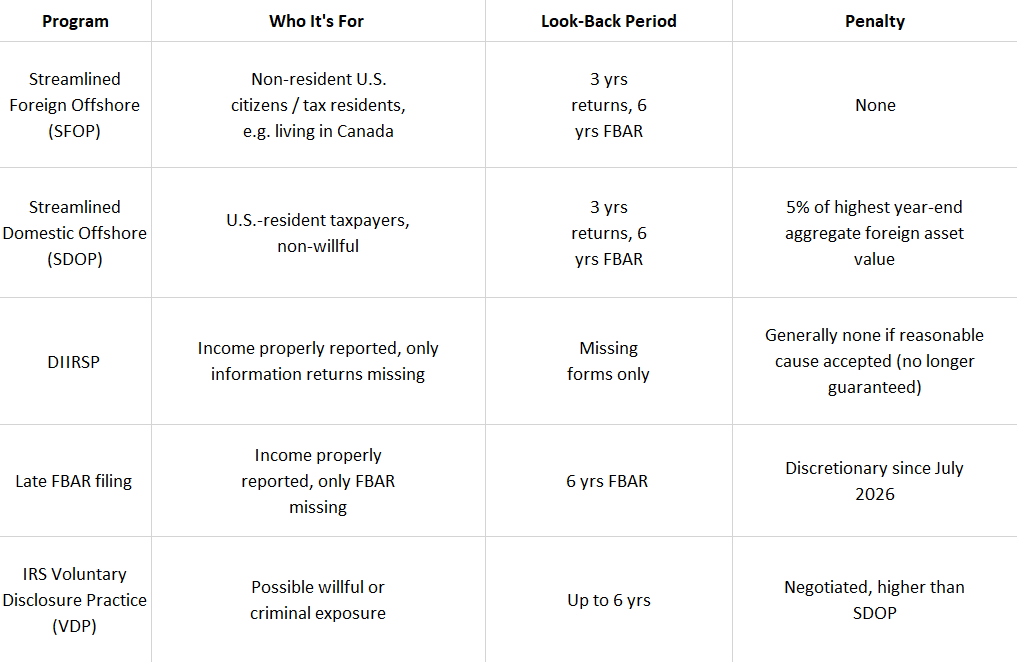
1. Streamlined Foreign Offshore Procedures (SFOP)
Best fit: U.S. citizens living in Canada, or Canadians who became U.S. tax residents but now reside outside the U.S., who meet the non-residency test — generally, in at least one of the most recent three years they did not have a U.S. abode and were physically outside the U.S. for at least 330 full days.
What it requires:
• 3 years of delinquent or amended U.S. income tax returns, including all required international information returns (8938, 3520, 5471, 8621)
• 6 years of FBARs
• A signed non-willfulness certification, Form 14653
The benefit: No FBAR penalty and no offshore penalty whatsoever. This is the most favorable program available, and it is the one most U.S. citizens permanently residing in Canada will qualify for. SFOP also allows original returns to be filed, not just amendments — which matters if you have never filed at all.
2. Streamlined Domestic Offshore Procedures (SDOP)
Best fit: Canadians who became U.S. tax residents and now live inside the United States, so they fail the non-residency test above, and whose prior non-reporting was non-willful.
What it requires:
• 3 years of amended U.S. income tax returns, including information returns
• 6 years of FBARs
• A signed non-willfulness certification, Form 14654
• A 5% miscellaneous offshore penalty
How the 5% is calculated: you take the total combined year-end value of all covered assets for each of the six years, identify the single highest year, and apply 5% to that figure once — not 5% per year.
The benefit: a penalty applies, but it is dramatically lower than the exposure outside these
programs, and it resolves multiple years in one filing.
3. Delinquent International Information Return Submission Procedures (DIIRSP)
Best fit: Someone who reported and paid tax on all income correctly but missed a specific information return — a Form 3520, or a Form 5471 for a Canadian corporation — where no tax is owed.
What it requires: File the delinquent returns with a reasonable cause statement. Depending on which form was missed, amending the related income tax return may also be required.
The benefit: If reasonable cause is accepted, severe penalties are typically abated. Be aware that since 2020 the IRS no longer guarantees abatement here — each submission is reviewed on its own facts. This route carries more uncertainty than Streamlined, but it is appropriate when income tax itself was never at issue.
4. Late FBAR Filing (Post-July 2026)
Best fit: Someone who reported all foreign income correctly but never filed the FBAR — the taxpayer the old Delinquent FBAR Submission Procedures were designed for.
What it requires: File the late FBARs electronically through FinCEN’s BSA E-Filing System, selecting a reason for late filing on the cover page.
The benefit: Penalty relief is still realistically achievable on reasonable cause grounds, but it is now discretionary rather than assured. Filing before the IRS contacts you remains the single most important factor.
5. IRS Voluntary Disclosure Practice (VDP)
Best fit: Taxpayers whose past noncompliance may be willful, or who have exposure that could be viewed as criminal — knowingly hiding income or foreign assets. This is not the typical situation for someone who simply didn’t know the rules, but it is the right program when willfulness cannot be ruled out.
One critical warning: written and verbal communications with a CPA or tax preparer can be summoned by the IRS and used as primary evidence of willfulness. If willfulness is a live question, the first call should be to a tax attorney, who can extend privilege — including over the accountant’s work, through a Kovel arrangement.
What it requires: A multi-step process beginning with a pre-clearance request to IRS Criminal Investigation, followed by full disclosure and up to 6 years of returns. The benefit: Protection from criminal prosecution, with civil penalties negotiated — generally higher than the 5% streamlined penalty, often calculated on the highest account balance across the disclosure period.
Comparing the Programs at a Glance
Canadian-Specific Traps to Know About
Ordinary Canadian savings and investment vehicles carry unexpected U.S. reporting consequences:
RRSPs and RRIFs
Since 2014 these generally no longer require a separate election or the old Form 8891, and
they receive favourable treatment under the Canada-U.S. tax treaty. But historical years
may still need review, and they remain reportable on the FBAR and Form 8938.
TFSAs
The IRS does not recognize the tax-free character of a TFSA. It is often treated as a foreign grantor trust, potentially triggering Forms 3520 and 3520-A, and all income inside it is taxable on the U.S. return. The single most expensive account in a typical Canadian portfolio, from a U.S. perspective.
Canadian mutual funds and ETFs
Frequently classified as Passive Foreign Investment Companies (PFICs), triggering onerous Form 8621 reporting and, without a proper election, punitive default tax treatment that can approach confiscatory rates on long-held positions.
Principal residence
Canada’s principal residence exemption has no exact U.S. equivalent. The U.S. capital gain
exclusion on a home sale has different dollar limits and eligibility rules, so a Canadian
home sale can create real, unexpected U.S. tax.
Canadian corporations
Owning a Canadian-controlled private corporation can trigger Form 5471 and, depending on structure, exposure to GILTI rules. Form 5471 is among the most demanding IRS forms — most of the work is building foundational workpapers before form preparation even begins.
Compliance costs for a simpler Form 5471 typically range from $1,000 to $2,000+ perform, depending on the state of the foreign financial statements, GILTI calculations, available international elections, and structural complexity. A dormant entity with no activity can be filed for a baseline fee of $500.
Two Illustrative Scenarios
Scenario A — The accidental American in Toronto. A U.S.-born citizen has lived in Toronto her entire adult life, filing Canadian returns and paying Canadian tax, but never filed a U.S. return because she didn’t know she had to. She holds an RRSP, a TFSA, and a Canadian brokerage account. Because she lives outside the U.S. and meets the physical
presence requirement, she is a strong candidate for SFOP — 3 years of returns, 6 years of FBARs, and no penalty. Her TFSA and any mutual funds will drive most of the preparation work.
Scenario B — The Canadian who moved south. A Canadian citizen moved to the U.S., became a U.S. tax resident, and kept a Canadian bank account and a mutual fund account, neither ever reported. Because he now lives in the U.S., he fails the non-residency test, so SDOP applies — the same 3-year and 6-year filing requirement, but with a 5% penalty on
the highest combined balance of the unreported foreign assets.
Steps to Take
1. Get a complete picture first. Before filing anything, gather account statements, RRSP/TFSA/RESP records, and prior Canadian and U.S. filings for the full look-back period.
2. Assess willfulness honestly. This determination drives which program applies. It should be made with a qualified cross-border professional, not assumed — and if the answer is unclear, involve a tax attorney before creating a paper trail.
3. Determine your U.S. residency status. Whether you meet the non-residency test for SFOP versus SDOP turns on facts and circumstances, not on which passport you hold.
4. Prepare returns and information forms together. These programs require multiple years filed simultaneously, as one coordinated package — not one year at a time.
5. File once, correctly. Streamlined submissions generally cannot be undone or resubmitted. Accuracy on the first attempt matters more here than on almost any other filing.
6. Consider state tax exposure. If you have ties to a U.S. state, its voluntary disclosure program is separate from the federal ones described here.
7. Move before the IRS moves. Every program above becomes unavailable once you are under civil examination or criminal investigation, or once the IRS contacts you about the missing filings.
Talk to a Cross-Border CPA Before You File
Coming forward proactively — before the IRS identifies you through FATCA data matching — almost always produces the better outcome: lower penalties, a defined scope, and a clean slate going forward. Waiting produces the opposite, and the 2026 changes show the safe harbors are narrowing, not widening.
Ricky Chawla CPA Professional Corporation works with U.S. citizens in Canada and Canadians who have become U.S. tax residents on exactly these filings — determining program eligibility, preparing the coordinated multi-year package, and handling the Canadian side of the return at the same time.
This article is intended for general informational purposes only and does not constitute individualized tax, legal, or accounting advice. Eligibility for each program depends on the specific facts of your situation, including residency history, willfulness, and asset composition. If you believe you may have unreported foreign income or unfiled U.S. information returns, consult a CPA or tax attorney experienced in U.S./Canada cross border tax compliance before taking action.